Recognizing a Need for Dialogue
Local and national perspectives vary regarding Columbus and Indigenous Peoples Day, as well as over monuments dedicated to the 15th-century figure. The City of Syracuse engaged the community organization, InterFaith Works, that is dedicated to using dialogues to create bridges to understanding, and support decision making.
The goal of these dialogues was to allow concerned individuals and groups in our community to be heard by one another and, in doing so, come to a mutual understanding of:
- memorializing an explorer who has a mixed legacy regarding slavery and colonization of the Americas;
- attitudes toward Italian Americans who migrated to America at turn of the 19th century, and that community’s efforts to validate their contribution through such monuments;
- how the monument may appear to ignore perspectives of other oppressed communities in our region.
Feedback from the dialogues indicated that the participants appreciated new and profound insights into each other’s histories. A common outcome was to create a new public space that celebrates the many cultures of the region and recognizes all communities that have shown resilience in the face of oppression. It was determined that Onondaga Historical Association (OHA) had the historical resources to inform a call for design ideas for this commemorative space and to lead a path forward.
Onondaga Historical Association Takes the Lead
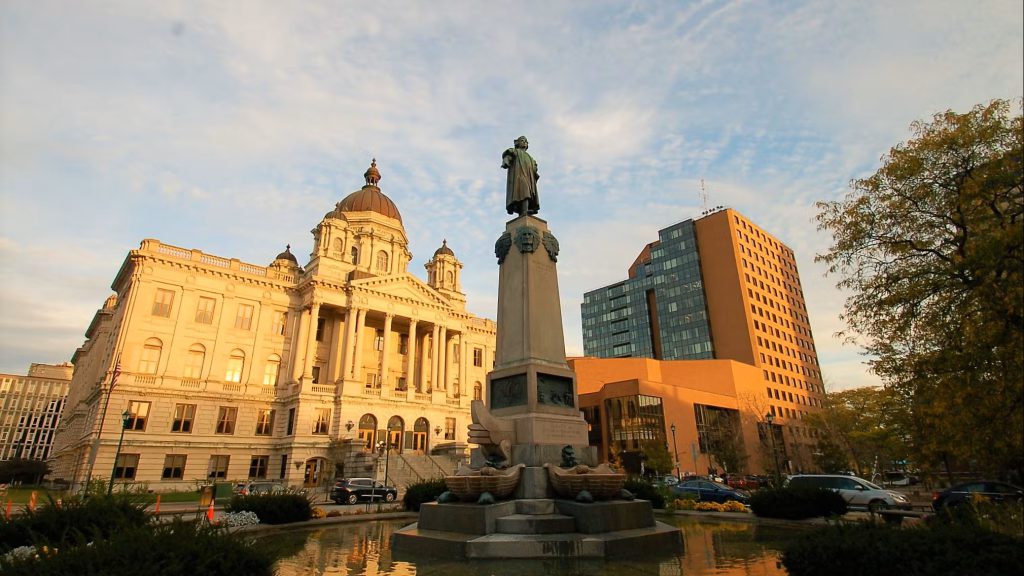
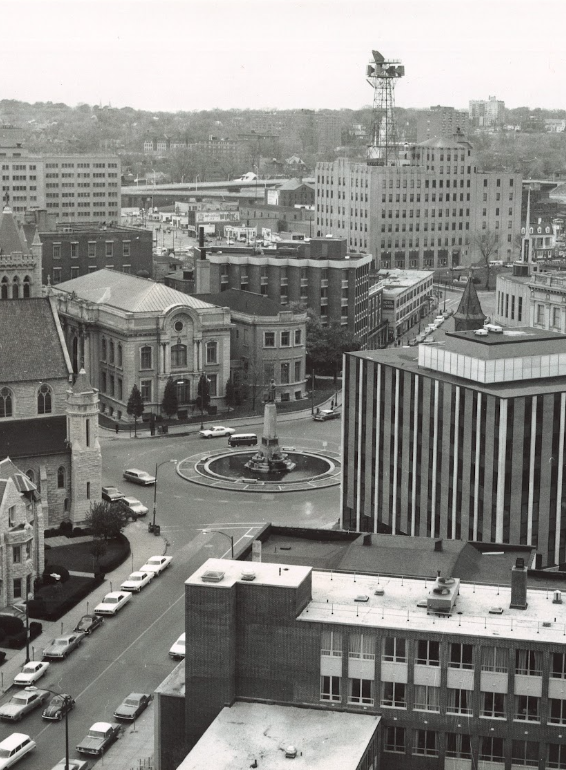
While no consensus emerged from the community dialogue circles as to what should be done with the public space in question, there was general agreement that the public space known as Columbus Circle and neighboring, city-owned vacant lot, known as the Powelson Site, did warrant further discussion and ideation as a heritage and education site.
Soon thereafter, OHA received private funding, enabling the formation of a project team — which included Forecast Public Art. The non-profit consulting firm provides communities with technical assistance as they work to share untold stories and history in their commemorative spaces. process, soliciting ideas for public spaces, and accounting for community feedback in such projects.
The result is The Full Circle Design Competition.
The Full Circle Design Competition
Forecast Public Art, a non-profit, organization with national experience, will assist OHA with coordination of a design competition to invite proposals for the project site. The firm interviewed stakeholders and will manage the competition invitation, and facilitate the work of the Curatorial Committee to evaluate proposals, identify finalists to advance to the public exhibition phase, and select the winning design.
OHA’s position on the Columbus Monument is neutral. Guidelines for the competition will not specify if designs must leave the monument and bronze elements in place, relocate them, or repurpose them in the design.
“An open process ensures a full range of creative ideas and approaches to design a community space that recognizes the resilience of the many generations of people who have called this their home,” says Lisa Romano Moore, Executive Director of OHA.
The winning design should be selected at the end of the 2026 calendar year.
Materials gathered from OHA’s archives and collections will help inform the artists and design teams about the history and cultures of Syracuse, and give important details about the project site and the Columbus monument. This repository will continue to be available digitally for future generations to use for research, education and genealogy purposes, and can be utilized toward the development of interpretive signage in the finished space.
“This repository of digitized materials will include documents, images, historic newsreel footage, and documentary content, available on a project website,” says Romano Moore. “Longer term, our intent is for the website to provide visitors with the opportunity to experience the site virtually, reinforcing our mission to share the stories of this region with people around the world.”